The Roots: Ancient Foundations to 1801
The three-thousand-year foundation of Georgian civilization
I. The Ancient Foundations of Identity
Long before the Iron Curtain fell across Europe, and indeed long before the Slavic tribes organized into the Kievan Rus, the region now known as Georgia was a center of high civilization and the setting for one of Greek mythology's most enduring sagas.
The Myth and Reality of Colchis and Iberia
To the Greeks of classical antiquity, the western Georgian kingdom on the Black Sea coast was known as Colchis (Egrisi). This was the fabled destination of Jason and the Argonauts, the land of the Golden Fleece, and the home of the sorceress Princess Medea. This mythological association is not merely a literary curiosity; it serves as a critical indicator of Georgia's ancient cultural orientation.
The myths place Georgia firmly within the Mediterranean and Hellenic world, rather than the northern steppes. Archaeological excavations confirm that Colchis was a sophisticated polity with advanced metallurgy, particularly in gold—giving credence to the "Golden Fleece" legend as a metaphor for the region's mineral wealth (some scholars link this to Georgia's ancient wine-making tradition)—and thrived as early as the 13th century BC.
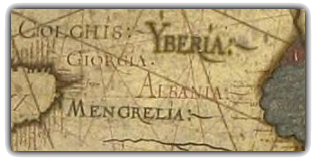
The ancient kingdoms of Colchis (west) and Iberia (east) formed the foundation of Georgian civilization.
The Kingdom of Iberia
Parallel to Colchis in the west lay the Kingdom of Iberia (Kartli) in the eastern interior. It is crucial for the Western observer to distinguish this Caucasian Iberia from the Iberian Peninsula of Spain and Portugal. Caucasian Iberia represents the nucleus of the Georgian statehood that would eventually unify the diverse tribes of the region.
These kingdoms were not isolated backwaters but active participants in the geopolitical struggles of antiquity, serving as buffer states and battlegrounds between the Roman Empire and the Persian Empires (Achaemenid, Parthian, and Sassanid). Their strategic location at the crossroads of Europe and Asia made them perpetual prizes in the great power competitions of the ancient world.
II. The Christian Pillar and the Apostolic Legacy
The single most defining characteristic of the Georgian identity—and the one that provided the resilience necessary to survive centuries of encirclement by Islamic empires—is its apostolic Christianity.
Tradition holds that the Apostle Andrew was the first to preach the Gospel in the region, traveling widely through what was then Iberia and Colchis. However, the state's official conversion occurred in the 4th century (c. 337 AD) through the ministry of Saint Nino of Cappadocia, a woman who is revered as the Enlightener of Georgia.
This pivotal event made Iberia the second state in the world, after neighboring Armenia, to adopt Christianity as its official religion.
This decision was as geopolitical as it was spiritual. By embracing Christianity, the Georgian kings aligned themselves decisively with Rome and later the Byzantine Empire, creating a permanent cultural and political schism with the Zoroastrian Persian Empire to the south.
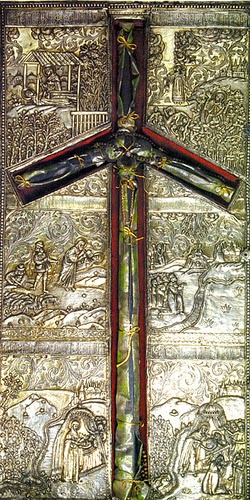
Saint Nino's grapevine cross became the symbol of Georgian Christianity and national identity.
This "Western" orientation, anchored in faith, would become the recurring motif of Georgian history. The cross became the symbol of national survival; to be Georgian was to be Christian, and to preserve the faith was to preserve the nation. (Learn more about the Georgian Orthodox Church.)
III. The Linguistic Fortress: The Three Alphabets
Intrinsically linked to this religious identity is the Georgian language (Kartuli) and its unique script. Unlike the Cyrillic alphabet imposed during the Soviet era or the Latin script of the West, Georgia possesses one of the world's few unique writing systems, a Kartvelian language unrelated to the Indo-European or Turkic language families.
The evolution of this script is a testament to the sophistication of Georgian culture. It has evolved through three distinct stages:
| Script | Meaning | Origin | Characteristic |
|---|---|---|---|
| Asomtavruli | Capital/Rounded | 5th Century | Geometric, circles and straight lines |
| Nuskhuri | Manuscript | 9th Century | Angular, distinct ascenders/descenders |
| Mkhedruli | Military/Secular | 11th Century | Rounded, cursive, modern standard |
This script, described by visitors as resembling "curling grapevines," is recognized by UNESCO as a piece of Intangible Cultural Heritage. The survival of this alphabet is not a trivial matter of linguistics but a story of political resistance.
The 1978 Language Protests
During the Soviet era, the Kremlin attempted to Russify the republic, but the Georgian language remained a red line. In 1978, when Soviet authorities attempted to remove the constitutional clause designating Georgian as the sole official language of the republic, thousands of students and citizens took to the streets of Tbilisi in protest.
This rare and successful act of defiance against the Soviet behemoth preserved the alphabet's status and signaled the enduring power of Georgian cultural nationalism.
IV. The Golden Age of Queen Tamar
To understand the depth of Georgian national pride and the historical benchmark against which modern leaders are measured, one must look to the "Golden Age" (11th–13th centuries), specifically the reign of Queen Tamar (1184–1213).
In a unique linguistic distinction reflecting her absolute power, she was often referred to as "King" (Mepe) Tamar. Her reign marked the zenith of Georgian political and military influence, a time when Georgia was not a vassal but an empire in its own right.
Military and Cultural Achievements
Under Tamar's leadership, the Georgian army unified the disparate feudal principalities and launched successful campaigns that expanded the kingdom's borders from the Black Sea to the Caspian Sea. Georgia exerted protectorate status over parts of modern-day Turkey, Armenia, and Iran, and even helped establish the Empire of Trebizond in 1204 as a Byzantine successor state.
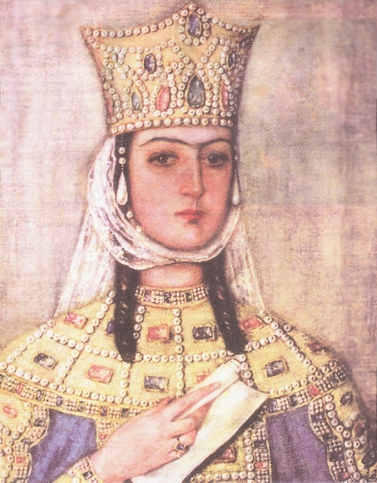
Queen Tamar's reign marked the peak of Georgian territorial expansion and cultural flourishing.
This era was characterized not only by military might—exemplified by victories such as the Battle of Basian—but by a profound cultural renaissance. It was during this period that Shota Rustaveli composed the national epic poem, The Knight in the Panther's Skin, a masterpiece of medieval Georgian literature that espoused humanistic values of friendship, loyalty, and gender equality.
Legal Humanism
Tamar's reforms included the abolition of the death penalty and torture, marking a period of legal humanism that stood in stark contrast to the brutality of the era. For the modern Georgian citizen, the Golden Age is proof that their nation is not destined to be a victim of geography, but is capable of being a regional hegemon and a center of high culture.
Explore the Golden Age in Depth
The 11th-13th centuries represent Georgia's territorial and cultural peak. Read our comprehensive guide to the Golden Age, including Queen Tamar's reign, Rustaveli's epic, Georgia's maximum territorial extent, and how the Mongol invasions brought this golden era to an end.
V. Mongol Invasions and Fragmentation
The glory of the Golden Age came to a devastating end with the arrival of the Mongols in the 1220s. The Mongol invasions shattered the unified Georgian kingdom, forcing it into tributary status and subjecting it to heavy taxation and periodic raids.
The 14th century brought further catastrophe with the Timurid invasions. Timur (Tamerlane) devastated Georgian cities, causing sharp population decline and destroying centuries of accumulated wealth and cultural artifacts.
Despite this destruction, cultural continuity survived. The church preserved manuscripts, the aristocracy maintained genealogical memory, and the mountain regions remained unconquered, serving as refuges for Georgian identity.
Persia and Ottoman Contestation
By the early modern period, Georgia had fractured into multiple kingdoms and principalities, caught between two expanding empires: Safavid Persia to the south and the Ottoman Empire to the west. Georgian kings became masters of diplomatic maneuvering, playing one empire against the other to preserve what autonomy they could.
Forced deportations of Georgians occurred under Safavid Persia, particularly Shah Abbas I's campaigns. Many Georgian nobles served in Persian administrations, and some converted to Islam to preserve their status. However, Christianity remained the defining marker of resistance and national identity.
VI. The Road to Russian Annexation
The Treaty of Georgievsk (1783)
By the late 18th century, the fragmented Georgian kingdoms faced existential threats from resurgent Persian and Ottoman empires. Seeking a fellow Christian protector, King Erekle II of Kartli-Kakheti signed the Treaty of Georgievsk with Imperial Russia in 1783.
The agreement was intended to guarantee Georgia's internal sovereignty and the preservation of its royal dynasty in exchange for Russian control over Georgian foreign affairs.
A Legacy of Betrayal
However, the treaty is viewed by Georgian historians as the first in a long line of Russian betrayals. Instead of protecting the kingdom, Russia stood by during the devastation of Tbilisi by Persian forces in 1795.
Then, in 1801, Tsar Alexander I violated the treaty's core tenets by annexing the Kingdom of Kartli-Kakheti entirely, abolishing the Bagrationi monarchy—one of the oldest in Christendom—and revoking the autocephaly of the Georgian Orthodox Church.
This historical trauma—the realization that an invitation for security guarantees led to total absorption— resonates profoundly in current political discourse regarding Russian peacekeepers and alliance offers.
Key Takeaways: The Roots
- Ancient Civilization: Georgia's history begins not in 1991 or 1801, but in the 13th century BCE with Colchis and Iberia.
- Christian Identity: Adoption of Christianity in 337 CE created a permanent Western orientation and became the cornerstone of national survival.
- Unique Script: The three Georgian alphabets represent cultural sophistication and resistance to assimilation—preserved even under Soviet rule.
- Golden Age: Queen Tamar's reign (1184-1213) demonstrated Georgia's capacity for empire, cultural achievement, and legal humanism.
- Survival Through Fragmentation: Despite Mongol, Timurid, Persian, and Ottoman domination, Georgian identity survived in mountain refugia and ecclesiastical institutions.
- The Russian Betrayal: The Treaty of Georgievsk (1783) led not to protection but to annexation (1801), a historical trauma that shapes modern Georgian-Russian relations.